
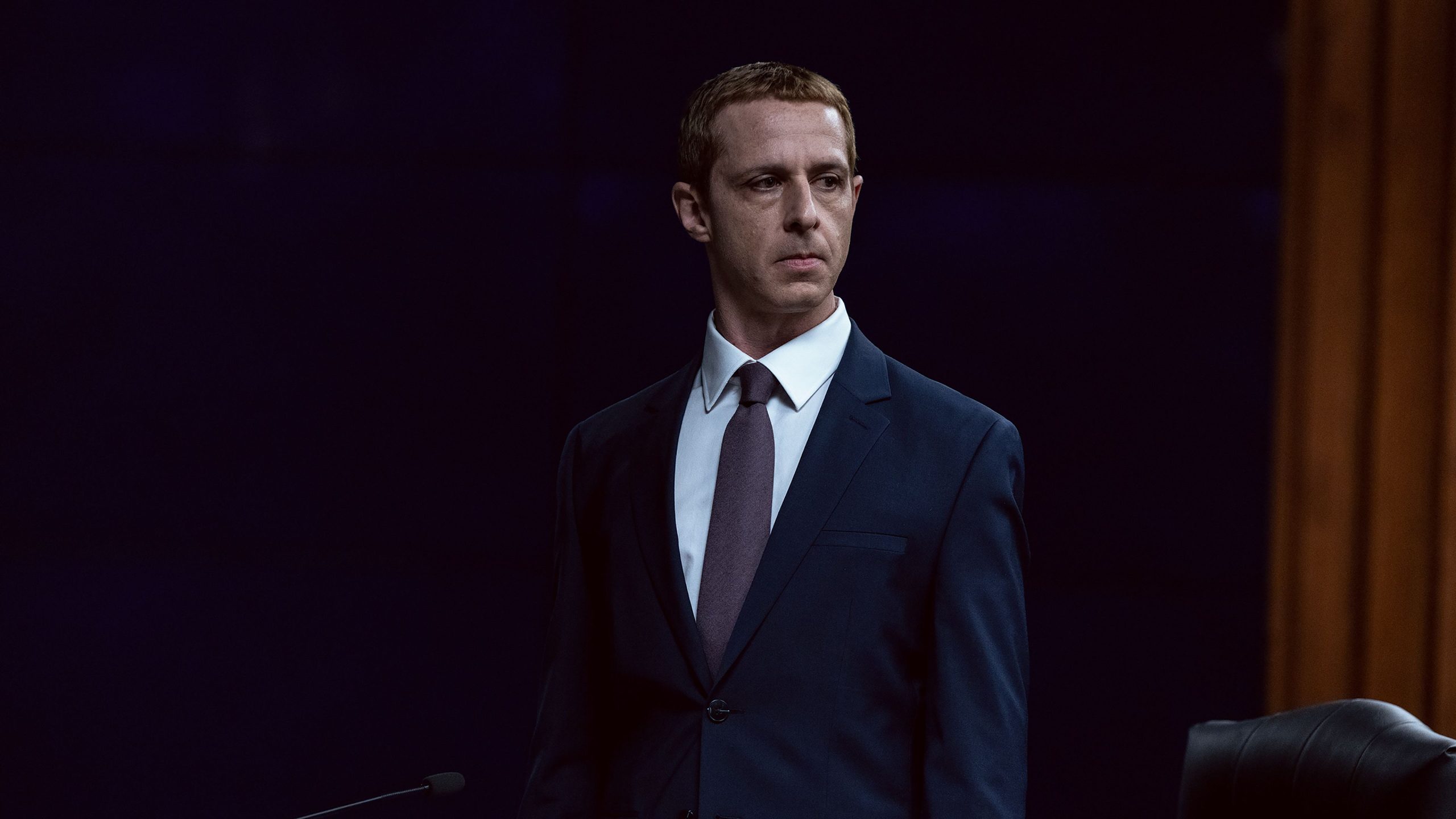
Thescreescore – The highly anticipated standalone sequel, The Social Reckoning, has finally unveiled its initial critical responses, immediately sparking a fervent discourse among film journalists. This cinematic follow-up sees Aaron Sorkin not only return to pen the screenplay but also step into the director’s chair, a significant departure from David Fincher’s iconic touch on the 2010 original, The Social Network. Shifting its focus from the nascent days of Facebook to the explosive 2021 data leak, the narrative features Jeremy Strong taking on the challenging role of Mark Zuckerberg, a character famously brought to life by Jesse Eisenberg.
The initial wave of reactions paints a picture of a film far more polarizing than its predecessor, which garnered widespread critical acclaim and three Academy Awards. Critics are divided on its timeliness, Sorkin’s directorial vision, and the performances of its ensemble cast.
Matt Neglia, for instance, voiced concerns that the material feels somewhat belated, suggesting it’s "arriving five years too late." While acknowledging Sorkin’s signature rapid-fire dialogue and relentless pacing, Neglia notes the often-unrealistic cadence of the conversations, where characters "plow through facts and figures at a mile a minute."

Related Post


Conversely, Tom Chatalbash champions the film’s enduring relevance, hailing The Social Reckoning as a "timely and compelling companion piece" that shares more thematic DNA with Sorkin’s acclaimed series, The Newsroom. Chatalbash particularly praises the ensemble, highlighting Jeremy Strong’s "ferocious force" as Zuckerberg, transcending mere imitation. He also commends the "quietly magnetic" performances of Mikey Madison and Jeremy Allen White, alongside Bill Burr and Betty Gilpin, who seem "born and bred to deliver Sorkin dialogue."
Joey Magidson, while admitting the film doesn’t quite reach the "masterpiece" heights of The Social Network, found himself "fully engaged." He describes a "slow and steady build" culminating in a "climax that suitably got my blood boiling," ultimately deeming it an engrossing and important "companion piece" to Sorkin’s earlier exploration of Facebook. Manuel São Bento echoed this sentiment, placing The Social Reckoning "on the same pedestal" as its predecessor, arguing that "this one matters more!" São Bento characterizes the film as an "infuriating" exposé of a company’s knowing culpability, calling it "one of the most riveting films I’ve seen this year."
However, not all reactions are glowing. Paul Klein expressed disappointment, lamenting the palpable absence of Fincher’s distinctive directorial magic. Klein criticized some "lackluster" acting and suggested the film ironically "misses its own point," ultimately dismissing it as a "shrug of a film."
Luke Hearfield, initially a "complete skeptic," found himself pleasantly surprised. He lauded The Social Reckoning as a "solid sequel" that "completely justifies its existence" as a "scathing indictment of the current tumultuous state of society." Hearfield described the film as the "origin story of ragebait," leaving audiences "furious once the credits roll." He singled out Mikey Madison’s "meaty work," Jeremy Strong’s "robotic" (in a positive sense) portrayal, and Jeremy Allen White’s "measured performance." While acknowledging Sorkin’s writing remains the "hero ingredient" compared to his direction, and the ending verges on "corny," Hearfield still left "very impressed."
This initial, varied reception stands in stark contrast to The Social Network‘s near-universal praise, which boasts a "Certified Fresh" 96% critics’ score on Rotten Tomatoes and remains widely regarded as one of David Fincher’s finest works. The original film was also a significant box office success, grossing $224.5 million globally against a $40 million budget. The more divisive critical landscape and questions surrounding the 2021 Facebook leak’s contemporary relevance could present a challenge for The Social Reckoning at the box office.
The casting of Zuckerberg also draws a clear distinction. While Jesse Eisenberg’s portrayal in 2010 received near-universal acclaim, Jeremy Strong’s interpretation is met with split opinions. Sorkin himself had reportedly made multiple attempts to convince Eisenberg to reprise the role, but the Academy Award nominee declined, citing a desire to distance himself from a figure whose controversies have only intensified since 2010.
Despite the mixed bag, some early reactions position The Social Reckoning as a potentially significant film of the year, possibly vying for Best Picture consideration. Another writing nomination for Sorkin seems plausible, though it’s unlikely to match the eight Oscar nominations secured by its predecessor.
The film’s narrative centers on Jeff Horwitz (Jeremy Allen White), the Wall Street Journal reporter who collaborated with Facebook data engineer and whistleblower Frances Haugen (Mikey Madison) to expose thousands of internal documents. The ensemble cast also features Bill Burr, Betty Gilpin, Wunmi Mosaku, and Billy Magnussen.
The Social Reckoning is slated for theatrical release on October 9.






Leave a Comment